|
EQUINE CLICKER TRAINING..... using precision and positive reinforcement to teach horses and people |
![]() |
|
Targeting
Targeting
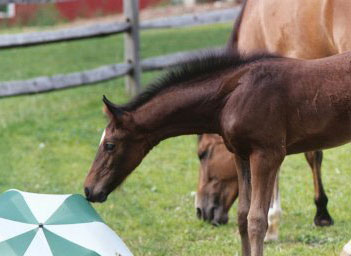
is a good way to introduce clicker training to horses. In the easiest version of "targeting", the
horse is taught to touch an object with its nose. Through targeting,
the horse learns that the click marks a specific behavior,
and that it will be followed by a reinforcer. I like starting with targeting because it is a behavior most people and horses don’t know, so there is no emotional baggage associated with it. You can’t force it and you can learn a lot about your horse by teaching it. In addition, it comes with a cue, which is the presentation of the target, so it is easy to get under stimulus control.
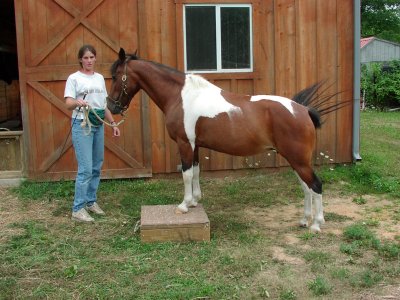
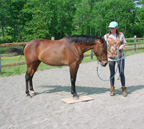
Stationary targets are placed in one location and the horse is either parked at them, or sent to them. Popular stationary targets are mats, milk jugs or other objects that can be tied in different locations, boat bumpers (this is what Shawna Karrasch uses), cones and pedestals. Any object can be treated like a stationary target once you have targeting on cue so you can ask a horse to target items any item that it is safe for them to touch.
Hand held targets are carried by the handler and used for targeting exercises that involve motion. A good hand held target has an obvious targeting location on one end. You can easily make a hand held target by putting a larger object on the end of a dowel or old whip. I have seen targets where the targeting "hot spot" is made out of pieces of pool noodle, tennis balls and water bottles. It really doesn't matter but for a hand-held target, you do want to be able to hold the target so the "hot spot' is out away from you.
APPLICATIONS FOR TARGETING: Leading: teach the horse to follow a hand held target
Standing while tied: teach the horse to stand on a target (mat) or keep its nose near or on a target
Ground tying: teach the horse to stand on a target (mat) or stay near a target
Lungeing: teach the horse to follow a target moving in a circle, or go from target to target so that it travels on a circle
Trailer loading: teach the horse to follow a target on to a trailer or go to a stationary target on a trailer
Stall manners: teach the horset to back to or stand next to a target when you are working in the stall
Approaching scary objects: teach a horse to target new items so that instead of being scary, they are opportunities for reinforcement
Obstacles/trail courses: you can use foot targeting (touch the foot to the object) to train horses to walk on or over obstacles
First aid and husbandry issues: horses can learn to target with other body parts. If you have to medicate an eye, teach the horse to put the eye in your hand and hold it there. You can do the same thing with feet and other body parts using the idea of holding on a target.
Worming: teach the horse to target the syringe.
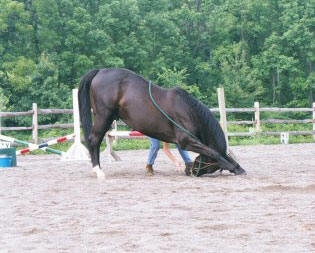
Liberty work and trick training: targets can be used in lots of areas, from sending horse to locations, to directing body parts for lateral work, rears, laying down, sitting, spanish walk, etc..
Games that involve picking things up/indicating with the nose: targets can be used to get horses started on the idea of using their nose or mouth to manipulate things. This includes things like playing fetch, soccer (with the nose or feet), indicating letters or colors with the nose or feet, holding things, drawing and painting and so on.
In-hand and groundwork: targets can be used to "direct body parts" in specific directions to teach lateral work (shoudler-in, haunches-in, half pass, sidepass, backing, backing in different directions, etc...)
Mounting block manners: teach your horse to line up at the mounting block through targeting, either of body parts under your direction of my teaching him to target a mat next to the block, or the block itself (with his side).
Haltering and bridling: teach the horse to target the noseband (halter) or bit (bridle) so he can self halter or bridle.
Katie Bartlett (2011) - please do not copy or distribute without my permission
Home | Articles | Clicker Basics | Community | FAQ | Getting Started | Horse Stories | Links | Photos | Resources
|
||||